
Concrete Expansion Joint Sealing: Stop Water Before It Undermines Your Slab
Concrete moves. It expands in Texas summer heat and contracts on cold winter nights. It shifts when the soil beneath it swells with moisture and pulls back when that soil dries out. Expansion joints are built into concrete slabs, driveways, sidewalks, and flatwork specifically to manage that movement — but they don’t last forever.
When the joint material cracks, shrinks, or pulls away from the concrete edge, it leaves a direct pathway for water to move from the surface down into the soil supporting the slab. In the Greater Houston area, where heavy rainfall is a regular part of life and clay-heavy soils respond dramatically to moisture changes, that pathway causes real structural damage over time.
At Lonestar Leveling LLC, joint sealing is one of the services we perform both as a standalone repair and as a protective measure following concrete lifting, stabilization, and polyurethane injection work. We service residential and commercial properties throughout Crosby, Channelview, Baytown, Humble, League City, Deer Park, and the surrounding Greater Houston area.
Understanding Expansion Joints and Why They Matter
Before getting into what happens when joints fail, it helps to understand why they exist in the first place.
Concrete is a rigid material that doesn’t bend — it breaks. When a large continuous slab expands, contracts, or settles unevenly, the stress that builds up has to go somewhere. Without control joints, it goes into the slab itself in the form of random cracking. Expansion joints create intentional weak points — planned locations where the concrete can move slightly without transferring that stress into uncontrolled breaks across the surface.
The joint itself is typically a gap filled with a compressible or flexible material: foam backer rod, rubber, caulk, or specialized sealant. That filler needs to be flexible enough to compress as the concrete expands and stretch slightly as it contracts — all while maintaining a watertight seal at the surface.
The problem is that most filler materials degrade over time. UV exposure dries out and cracks sealants. Temperature cycling causes repeated compression and expansion that eventually fatigues the material. In Houston’s climate — hot, humid, with dramatic swings between dry spells and heavy rainfall — this degradation happens faster than in more temperate regions.
Once the joint material fails, the gap opens. And an open gap in a concrete joint is an invitation for water.
What Happens When a Joint Fails: The Damage Chain
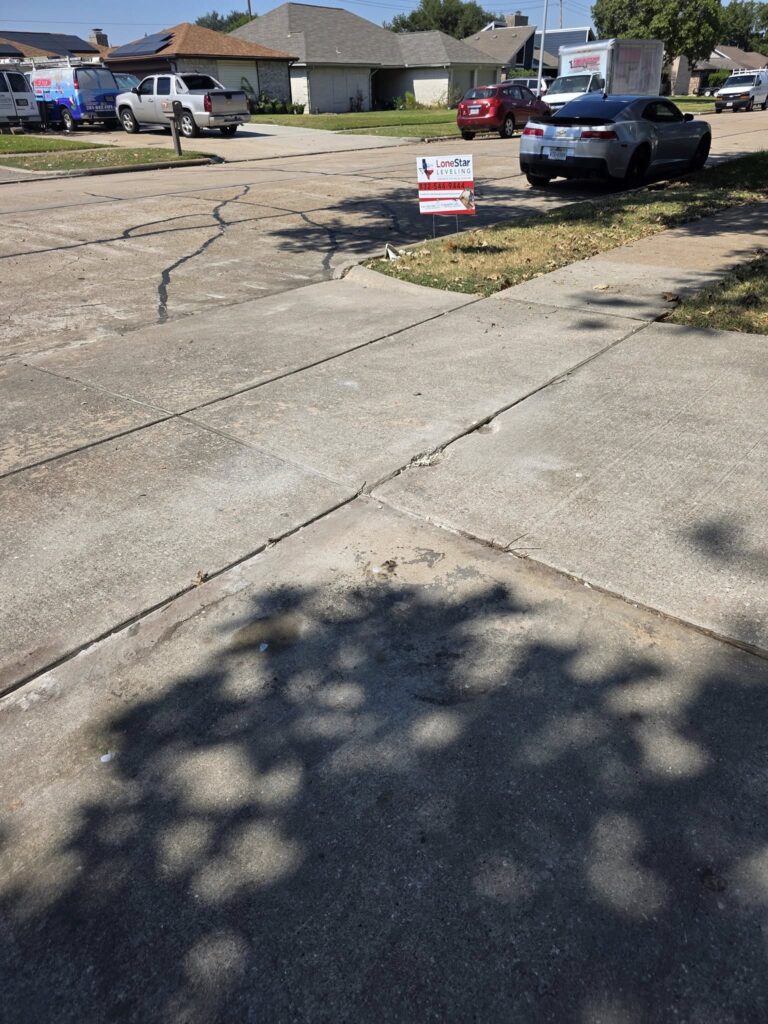
From the surface, a cracked or open expansion joint rarely looks urgent. It’s typically a thin line in a driveway, sidewalk, patio, or floor slab — easy to overlook, easy to add to the “I’ll deal with it eventually” list.
But beneath the surface, something is happening with every rain event and every irrigation cycle:
Water enters the open joint and travels downward into the soil beneath the slab. In Houston’s clay-heavy soils, that water doesn’t simply drain away — it saturates the clay, causes it to expand, then slowly washes fine soil particles out as it eventually drains or evaporates. Each cycle removes a small amount of material from beneath the slab.
Over months and years, those small losses accumulate. The bearing capacity of the soil beneath that section of slab drops. Voids begin to form — invisible gaps between the underside of the concrete and the soil surface below. The slab, which was designed to bear load on continuous soil contact, begins bearing load on a smaller and smaller effective support area.
Eventually, the slab cracks. Or it sinks. Or it settles unevenly, creating the trip hazards and drainage problems that bring property owners to the phone looking for help.
By that point, the repair involves more than sealing a joint — it involves addressing the voids and stabilizing the slab before any surface work is done. That’s a significantly larger and more expensive project than a joint sealing service would have been years earlier.
This is why we take expansion joint maintenance seriously and why we include it as a recommended follow-through step for clients who have recently had concrete lifted or repaired.
What Our Joint Sealing Service Includes
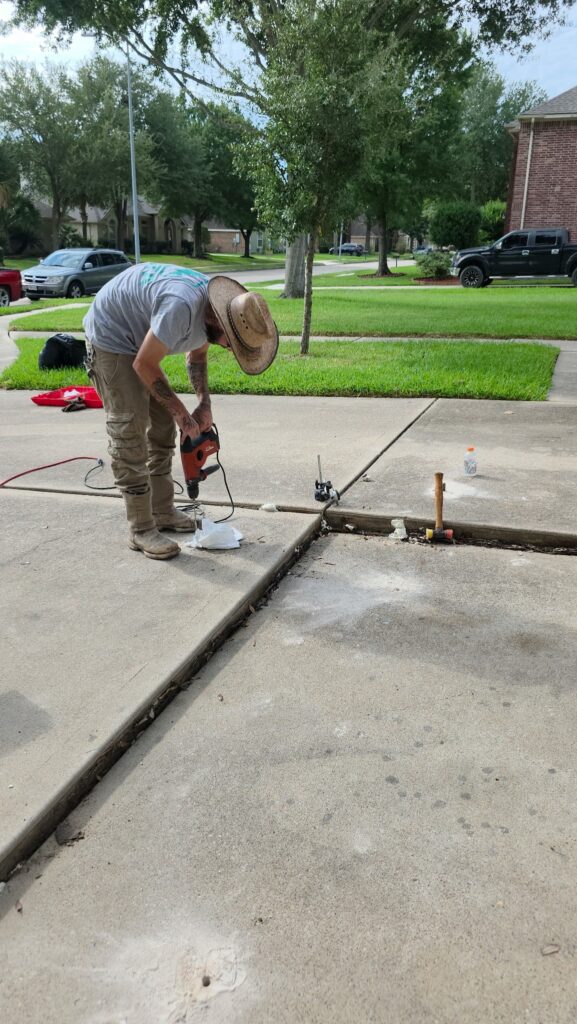
Professional joint sealing is not a caulk-gun job. The material has to flex with the concrete rather than crack under normal movement — and it has to bond tightly to both concrete faces to prevent water from working its way around the edges of the seal.
Our joint sealing process includes:
Joint Preparation
We clean the joint channel thoroughly, removing loose debris, failed sealant material, dirt, and any surface contamination that would prevent proper adhesion. This step is critical — even a high-quality sealant will fail early if it’s applied to a contaminated surface.
Backer Rod Installation
For joints with sufficient depth, we install a foam backer rod at the correct depth to establish the proper sealant profile. The backer rod controls the depth of the sealant and creates the correct shape for long-term flexibility performance. Skipping this step is one of the most common causes of premature joint sealant failure.
Sealant Application
We apply a professional-grade flexible sealant appropriate for the joint width, location, and application type. Exterior concrete joints exposed to vehicle traffic, foot traffic, and Houston weather require a different specification than interior control joints in a commercial floor. We select the right product for the specific application rather than using a one-size approach.
Tooling and Finishing
The sealant is tooled to ensure full contact with both concrete faces and a clean, finished appearance. A properly tooled joint sheds water cleanly rather than allowing it to pool at the edges.
The Benefits of Professionally Sealed Expansion Joints
- Prevents Water Intrusion The primary function of joint sealant is to keep surface water out of the joint and away from the supporting soil below. A properly sealed joint sheds water at the surface rather than funneling it downward.
- Reduces Soil Washout and Erosion When water can’t penetrate the joint, there’s no mechanism for the underlying soil to erode. This benefit is especially significant in Houston, where clay soils are vulnerable to both swelling and wash-out when exposed to repeated moisture cycles.
- Protects Recently Lifted or Repaired Concrete If Lonestar Leveling has lifted, leveled, or stabilized your concrete, joint sealing is a critical follow-through investment. Without it, water continues to infiltrate at the joint, and the same erosion process that caused the original settling will begin again. Sealing the joints after concrete lifting work helps protect the repair and extend its effective life.
- Preserves Property Value and Curb Appeal Cracked and open expansion joints look neglected. They create uneven drainage, accelerate surrounding concrete deterioration, and signal deferred maintenance to anyone evaluating the property. Clean, properly sealed joints look maintained — because they are.
- Extends the Service Life of the Entire Slab Concrete that sits on stable, well-supported soil performs far better over its service life than concrete experiencing repeated moisture infiltration, soil erosion, and re-settling cycles. Joint sealing is one of the most cost-effective ways to protect that long-term performance.
Extended 3-Year Warranty When Combined with Polyurethane Injection
When joint sealing is performed in combination with our exterior polyurethane injection service, Lonestar Leveling is able to offer an extended 3-year warranty on the work. Polyurethane injection fills subsurface voids and creates an additional barrier against water migration beneath the slab — addressing the problem both at the joint surface and in the soil profile below.
Together, these two services create a comprehensive, long-term solution rather than a surface-level patch. The joint sealant stops new water from entering. The polyurethane addresses any void space that has already formed. And the combined warranty reflects our confidence in the result.
Protect your concrete before water does the damage.
If you’re dealing with a slab leak, foundation issue, or under-slab repair, excavation and tunneling may be the most efficient and least disruptive solution available.
Call Lonestar Leveling at (832) 544-9444 or contact us online to schedule a joint sealing evaluation anywhere in the Crosby or Greater Houston area.