
Concrete Leveling & Foundation Repair in Pasadena, TX
Why Pasadena Properties Experience Heavy Foundation and Concrete Movement
- Clay Soil That Doesn’t Give Ground Pasadena sits squarely within the Harris County clay soil belt. The expansive clay in this area is thick, reactive, and highly sensitive to the moisture swings that Southeast Texas delivers regularly. During wet periods — and Pasadena gets significant rainfall, particularly during hurricane season — the clay absorbs water and expands. During dry stretches, it contracts and pulls away from whatever it was supporting. For a slab foundation or concrete flatwork, that cycle translates directly into differential movement. Edges of slabs that are exposed to weather dry faster than centers. Areas near plumbing penetrations, drainage features, or low spots in the yard stay wetter than the rest. The result is sections of the foundation or concrete surface moving at different rates simultaneously — which is what creates cracking, settling, and structural distress.
- A Long History of Heavy Industrial Surroundings Pasadena’s identity is closely tied to the petrochemical and refining industry along the ship channel. Decades of heavy truck and industrial traffic on streets throughout the city have contributed to vibration loading on residential and commercial slabs that accelerates soil compaction changes and can hasten the development of subsurface voids. Properties near major industrial corridors and freight routes may show concrete and foundation issues earlier than those in more sheltered residential areas.
- Decades of Built Environment Much of Pasadena was developed during the postwar boom of the 1950s through the 1970s, and a substantial share of the city’s housing stock carries the infrastructure challenges that come with that era: cast iron drain lines approaching or past the end of their service life, foundation construction methods that predated today’s soil engineering standards, and concrete flatwork that has been through 40 to 60 wet-dry cycles over its lifetime.
Signs Your Pasadena Property Needs Attention
Pasadena homeowners often first notice foundation and concrete movement in their interior spaces — a door that started sticking over the winter, a crack that appeared near a window corner, floors that feel slightly off when you walk from the living room toward the back of the house. These early signs are worth taking seriously, because in Pasadena’s soil environment, problems that are minor today tend to become moderate within a season or two if left unaddressed.
Here's a more complete list of what to watch for:
Inside the home:
- Doors — especially interior doors — that stick, drag, or no longer latch without effort
- Diagonal cracks running from the corners of door or window openings toward the ceiling
- Gaps between walls and ceiling, or walls and baseboards, that weren’t there before
- Floors that feel noticeably unlevel, particularly toward the outside walls of the home
- Cracks in drywall or plaster that have grown or multiplied over a single season
On the exterior:
- Stair-step cracking in brick mortar joints — the most reliable visual signal of differential foundation settlement in Houston-area slab homes
- Separation between window or door frames and the surrounding brick
- Cracks in the slab edge or foundation perimeter walls
- Gaps between the porch, steps, or garage floor and the main structure
On concrete surfaces:
- Driveway or sidewalk panels that sit noticeably lower on one side of an expansion joint
- Concrete that has cracked across the middle of a panel, not just at the joint
- Water that pools on flat concrete surfaces after rain — an indicator the surface is no longer draining as designed
- Concrete that sounds hollow when tapped — a void has formed beneath it
Both structural and flatwork problems are fixable. And in Pasadena’s soil conditions, both are significantly cheaper to address at the early-to-moderate stage than after another year of clay movement has extended the damage.
Our Services in Pasadena
Polyurethane Concrete Lifting
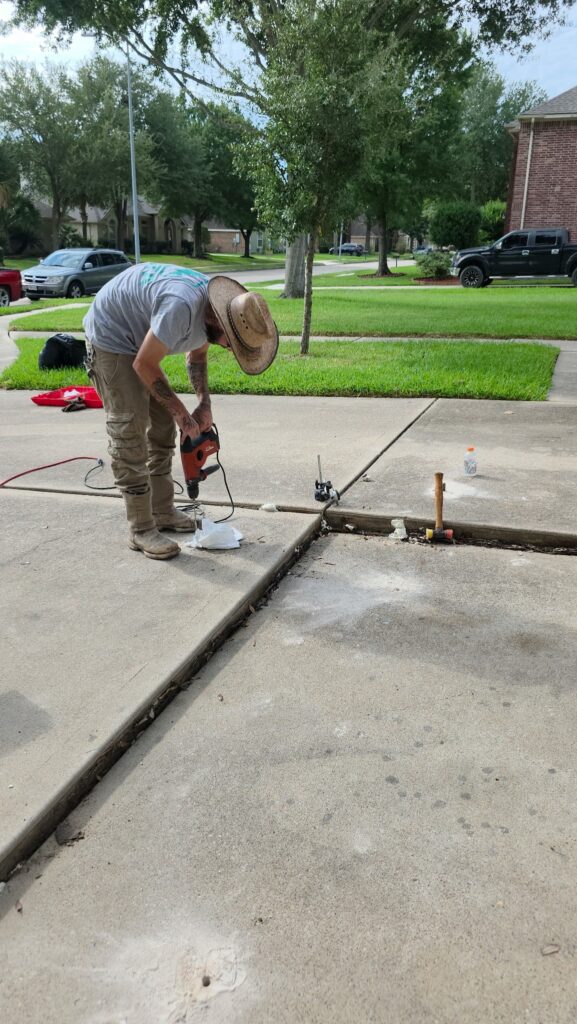
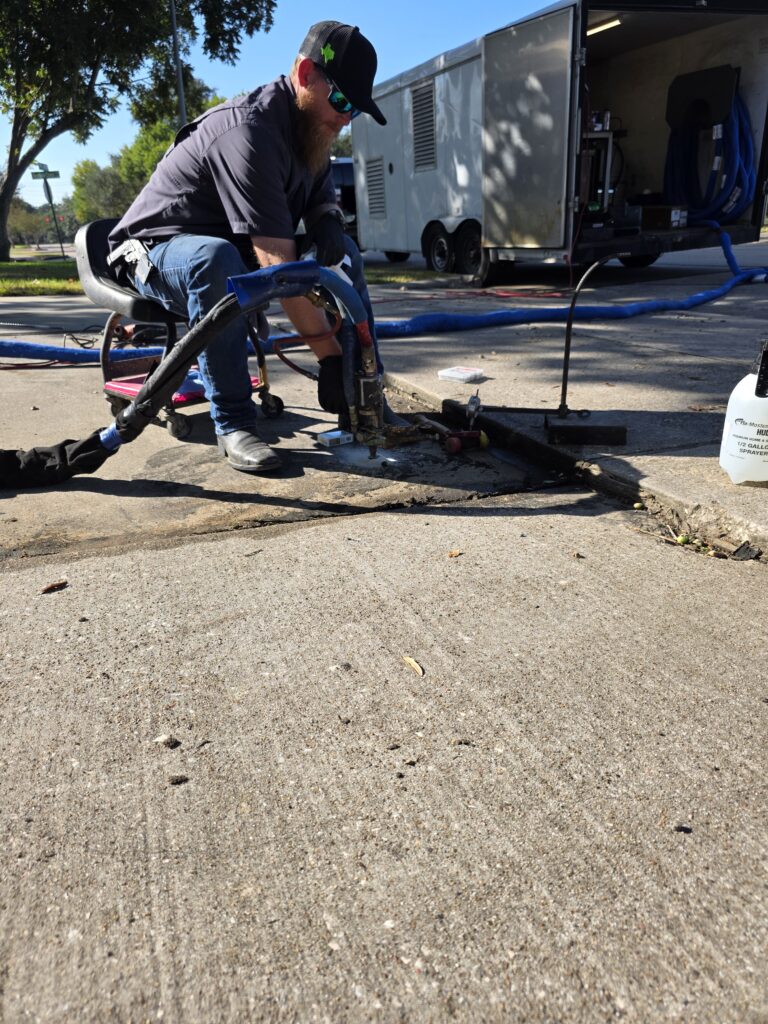
For settled driveways, sunken sidewalks, uneven patios, commercial flatwork, and any concrete surface that has lost bearing support beneath it. We inject high-density polyurethane foam through small ports drilled through the slab, fill the subsurface voids, and lift the concrete back toward its original position. The material cures in minutes — no waiting for new concrete to set, no heavy equipment tearing up the lawn, no color mismatch from a fresh pour next to existing concrete. Most residential concrete lifting projects are completed in a single day.
Foundation Repair & Structural Leveling
Owner-inspected, clearly documented, and warranted in writing. We assess the specific movement pattern affecting your Pasadena property and recommend targeted repair appropriate to the conditions — not a broad, high-dollar scope applied generically. Both slab-on-grade and pier and beam foundations are served. Every foundation job is followed up with written warranty documentation delivered directly to the customer.
Excavation & Tunneling
When under-slab access is needed for plumbing repair or pier installation, we tunnel from the exterior rather than cutting through interior floors. This is especially valuable in Pasadena’s occupied homes and active commercial properties, where interior disruption carries real cost beyond just the repair itself. No flooring removed. No dust throughout the interior. No curing delay after the repair.
Joint Sealing
Sealing deteriorated expansion joints in Pasadena driveways, walkways, and commercial slabs stops water infiltration at the surface before it erodes the supporting soil and creates the voids that lead to settling. Professional joint sealing with the correct backer rod and sealant specification lasts far longer than standard caulk applications and flexes with the concrete through seasonal movement. Extended 3-year warranty available when joint sealing is combined with polyurethane injection.
Owner-Led. Locally Operated. Competitively Priced.
Lonestar Leveling isn’t a franchise operation with a commissioned sales force and regional overhead built into every estimate. We’re a locally owned company based in Crosby, operating throughout east and southeast Harris County with more than 12 years of hands-on field experience. When you contact us for a Pasadena property inspection, the owner comes out personally — before any scope is set or pricing is provided.
That means your estimate reflects what the job actually requires, evaluated by someone with real field experience in Houston’s soil conditions. Not a commissioned estimator working from a sales script. Not a call center scheduling an appointment for a crew you’ve never spoken with.
We launched Lonestar Leveling specifically to deliver the quality of work we’d spent years providing as subcontractors, directly to property owners at fair prices — with honest recommendations, clear warranties, and a company that answers the phone when you call.
Find Out What's Happening Beneath Your Pasadena Property — For Free.
Call (832) 544-9444 — the owner picks up, evaluates your situation, and gets you scheduled. Not ready to call? Submit our free estimate form and we’ll reach out within one business day. No obligation, no pressure, no commissioned sales rep — just a straight answer from a local professional with over 12 years of experience.