
Bulkhead Repair & Stabilization for Lake Properties: Protecting Your Shoreline the Right Way
Lake property in the Greater Houston area is a significant investment. The water access, the views, and the lifestyle that comes with lakefront living make these properties genuinely valuable — and the bulkhead that holds the shoreline in place is one of the most structurally important features on the lot. When it starts to fail, the damage isn’t limited to the wall itself. Soil loss, landscape erosion, and threats to adjacent structures can follow quickly.
Lonestar Leveling LLC provides professional bulkhead repair and stabilization services for lake property owners throughout the Greater Houston area. We bring the structural knowledge, hands-on experience, and owner-led project oversight that shoreline repair work demands — and we focus on correcting both the visible damage and the underlying conditions that caused it.
What a Bulkhead Actually Does — and Why It Matters
A bulkhead is a retaining structure built at the water’s edge to hold the soil of the property in place against the constant pressure and movement of the water on the other side. It defines the boundary between your land and the lake, prevents the gradual erosion of your shoreline, and protects the soil beneath your lawn, landscaping, and any structures near the water’s edge.
Without a functioning bulkhead, the natural forces at the shoreline — water movement, wave action, fluctuating water levels, ice pressure in colder months, and the slow migration of saturated soil — will erode the land over time. What starts as a few inches of soil loss at the waterline eventually becomes a significant setback of the property edge, with consequences for everything from lawn area to the structural integrity of nearby decks, docks, or foundations.
Bulkheads are built from a variety of materials — concrete panels, timber, vinyl sheet pile, steel sheet pile, and combinations of these — and each construction type has its own maintenance and failure characteristics. What they all share is the need for periodic inspection and timely repair when deterioration begins.
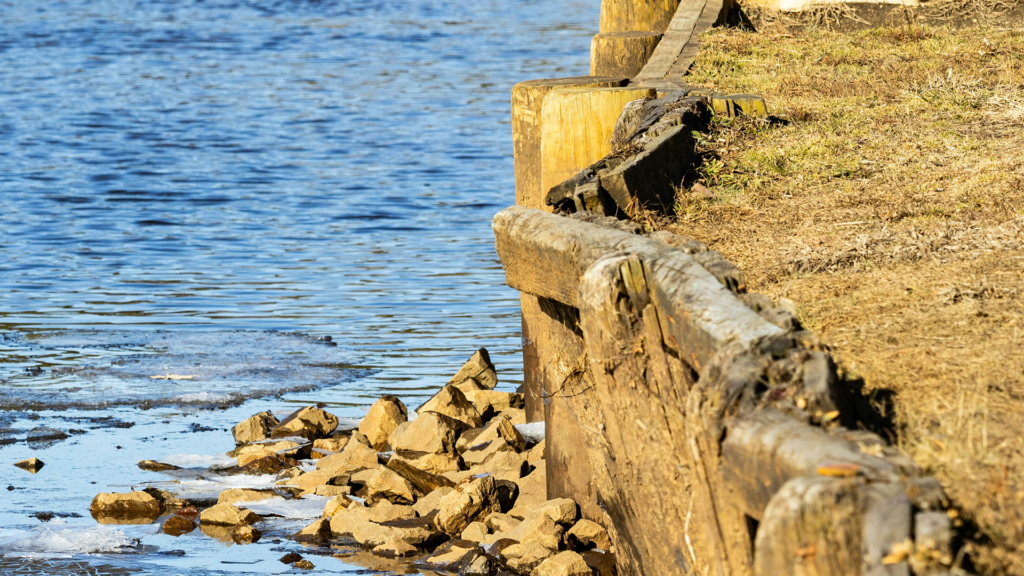
The Cost of Putting It Off
Bulkhead damage doesn’t stabilize on its own. Every storm, every rainfall, every season of water movement at the shoreline adds to the cumulative damage. A small erosion problem behind one panel grows. A single failed tie-rod shifts load to adjacent sections that weren’t designed to carry it alone. A minor void beneath the toe of the wall becomes a cavity that undermines a significant portion of the structure.
Property owners who address bulkhead problems early — at the first visible signs of movement, soil loss, or separation — consistently face smaller repair scopes, shorter timelines, and significantly lower total costs than those who wait until the failure is advanced. The delta between an early repair and a late repair is often the difference between stabilization work and full reconstruction.
Lonestar Leveling has been doing this work for years. We know what early-stage failures look like, and we know how to correct them before they become major projects. If you’re unsure whether your bulkhead needs attention, the most useful thing you can do is schedule an assessment and get a professional opinion.
Why Lake Property Bulkheads Fail
No bulkhead lasts indefinitely. The forces working against a shoreline retaining structure are constant, and no material is immune to the cumulative effects of water exposure, soil pressure, and time. Understanding the specific failure mechanism at work is the starting point for any repair that’s going to hold.
- Erosion and Backfill Washout Water moves constantly around, beneath, and behind a bulkhead — through gaps in panels, around the ends of the structure, and through the soil itself when saturation levels are high. Over time, that movement carries fine soil particles away from the backfill zone behind the wall. As the backfill volume decreases, the bulkhead loses the soil support it was designed to retain against, and it begins to move toward the water.
- Panel Separation and Joint Failure Bulkheads constructed from concrete panels, timber planks, or sheet pile develop gaps and separations as the structure ages and the materials weather. These gaps are more than cosmetic — they create direct pathways for water and soil to move through the wall, accelerating erosion of the backfill behind it. A small gap that gets ignored becomes a large separation as erosion widens the opening from behind.
- Anchor and Tie-Rod Failure Many bulkhead systems use tie-back anchors or deadman anchors buried in the soil behind the wall, connected by tie-rods that transfer the outward pressure of the retained soil into the anchor rather than letting it push the wall into the water. When these tie-rods corrode, loosen at the connection points, or when the anchors lose their holding capacity due to soil changes, the wall loses a major component of its structural resistance. Forward lean is often the first visible symptom of anchor system failure.
- Settlement and Forward Lean When the soil beneath the toe of the bulkhead erodes — either through water action on the lake side or through void formation beneath the structure — the footing loses support and the wall begins to tip forward. This condition is self-accelerating: as the wall leans, the geometry of the forces acting on it becomes less favorable, and the lean progresses faster. A bulkhead that is visibly leaning forward has usually been experiencing structural compromise for longer than it appears from the surface.
- Timber Decay and Material Deterioration Timber bulkheads, which are common on older lake properties, are subject to biological decay, insect damage, and the mechanical damage that comes from years of freeze-thaw cycling and waterline exposure. Once the wood structure begins to soften or lose cross-section, its structural contribution drops significantly, and sections of the wall can fail suddenly rather than gradually.
Our Bulkhead Repair and Stabilization Approach
The most important thing we do before any bulkhead repair is understand what actually caused the failure. A repair that addresses visible damage without treating the root cause will fail again — often faster than the original structure, because the conditions that caused the first failure are still active.
Our process starts with a thorough owner-led assessment of the bulkhead condition, the soil behind and beneath it, the water-side exposure, and the specific structural failure pattern at work. We look at how the wall is moving, where the soil loss has occurred, what the anchor system looks like, and what the construction type and materials require in terms of repair approach.
From that assessment, we develop a repair scope that is specific to the structure and the failure — not a generic fix applied to every job.
Depending on the bulkhead’s construction, age, and condition, repair and stabilization work may include:
Backfill Restoration and Compaction
Rebuilding the soil mass behind the wall that has been lost to erosion — using appropriate fill material placed in compacted lifts to re-establish the structural backing the bulkhead needs.
Void Filling
Addressing subsurface gaps and erosion channels that have formed beneath or behind the structure. Void filling stabilizes the soil profile and removes the hollow spaces that allow continued settlement and movement.
Anchor Repair or Replacement
Restoring the tie-back system that holds the wall in position against hydrostatic and soil pressure. When existing anchors have failed or lost capacity, new anchor points may need to be established farther back in the soil to regain the required resistance.
Panel and Joint Repair
Closing gaps, cracks, and open seams in the wall face that are allowing unfiltered water and soil movement through the structure. The specific repair method depends on the wall material and the nature of the gap.
Surface Protection Treatments
Applying coatings, sealants, or protective treatments appropriate to the wall material to extend the service life of the repaired structure against continued water and UV exposure.
Why Experience Matters at the Waterline
Shoreline structural work presents challenges that don’t exist in standard foundation or concrete repair. Access is limited. Water conditions affect scheduling and methodology. Work near Texas waterways carries regulatory considerations that require careful attention. The materials are subject to exposure conditions that most structural materials never face. And unlike a driveway or sidewalk repair, a bulkhead failure that isn’t corrected properly keeps failing — with your property continuing to pay the cost.
Lonestar Leveling LLC brings more than 12 years of structural repair experience to every bulkhead project. We’ve invested in the equipment, knowledge, and field experience that this type of work requires, and we approach every shoreline project with the same commitment to getting the root cause right that we bring to every job we take on.
Don't let a small shoreline problem become a major structural failure
If you’re dealing with a slab leak, foundation issue, or under-slab repair, excavation and tunneling may be the most efficient and least disruptive solution available.
Call Lonestar Leveling at (832) 544-9444 or reach out online to schedule your free bulkhead assessment anywhere in the Greater Houston area.